
Cleaning vs. Sanitizing vs. Disinfecting: What’s the Real Difference?
Cleaning vs. Sanitizing vs. Disinfecting: What’s the Real Difference?
Is cleaning enough to keep a space safe? No, and the difference between cleaning, sanitizing, and disinfecting is bigger than most people realize. It’s a gap that matters in schools, offices, healthcare settings, and anywhere people share surfaces all day.
Cleaning, sanitizing, and disinfecting get used as if they mean the same thing. They don’t. Each one does a different job, and treating them as interchangeable is one of the easiest ways to let germs keep spreading without realizing it.
Here’s what actually separates the three, when to use each one, and how to tell whether a product you’re using is doing what its label says.
Cleaning, sanitizing, and disinfecting get used as if they mean the same thing. They don’t. Each one does a different job, and treating them as interchangeable is one of the easiest ways to let germs keep spreading without realizing it.
Here’s what actually separates the three, when to use each one, and how to tell whether a product you’re using is doing what its label says.
What Is Cleaning?
Cleaning is the physical removal of dirt, dust, and some germs, usually with soap or detergent and water. It doesn’t kill pathogens. What it does is take away the grime that pathogens hide in, which is why cleaning first makes everything that comes after it work better. Most disinfectants perform best on a surface that’s already been cleaned.
In a classroom, this looks like wiping down desks, chairs, and counters to remove visible dirt and food residue. It’s the step that makes a space look and feel clean. It is not the step that makes a space safe from illness on its own.
Cleaning should happen regularly in high-traffic areas, generally once or twice a day in homes, offices, and schools, more often if the space sees heavy use.
What Is Sanitizing?
Sanitizing goes a step further than cleaning. It uses chemicals to reduce the number of germs on a surface to a level public health standards consider safe. It does not kill every pathogen present, it lowers the count enough to reduce the risk of illness spreading.
Sanitizing is the standard on surfaces that come into regular contact with food or with children’s hands and mouths: kitchen counters, cutting boards, cafeteria tables, daycare toys. The key distinction is that sanitizing reduces risk. It doesn’t eliminate it, and it isn’t designed to.
Sanitizing belongs after cleaning, on surfaces that don’t require full disinfection but still need germ counts kept low.
What Is Disinfecting?
Disinfecting is the most thorough of the three. A disinfectant is formulated to kill a broad spectrum of bacteria, viruses, and fungi outright, not just reduce their numbers. That’s a materially different job than cleaning or sanitizing, and it requires a different process to work.
Disinfectants need contact time, sometimes called dwell time, to do their job. The surface has to stay visibly wet with the product for a set period before the germs are actually killed. Wipe a surface once and walk away too quickly, and you’ve cleaned it. You haven’t disinfected it.
Disinfecting matters most on high-touch surfaces: door handles, light switches, desks, shared equipment, anything that gets touched by a lot of different hands throughout the day. It’s especially important during cold and flu season or any period of higher illness risk.
The Difference Between Cleaning, Sanitizing, and Disinfecting
This is the part that gets missed most often. Sanitizing and disinfecting are not two strengths of the same thing. They’re different processes with different outcomes, and one cannot substitute for the other.
Schools are a good example of why this matters. Students and staff share classrooms, bathrooms, hallways, and playgrounds all day, which makes it easy for illness to move from one person to the next. Public Health Ontario is clear that proper cleaning and disinfection, not sanitizing alone, are what actually prevent and control the spread of colds, flu, and COVID-19. A sanitized surface has fewer germs on it than a dirty one. It is not the same as a disinfected one.
How to Tell If a Product Actually Disinfects
Plenty of products on store shelves are labeled “antibacterial” or claim to “kill germs” without being legally allowed to call themselves disinfectants. In Canada, any product that claims to disinfect has to be authorized by Health Canada and assigned a Drug Identification Number, or DIN. Getting one requires the manufacturer to submit efficacy data proving the product actually kills the organisms it claims to, within a specific contact time, under standardized testing.
A product without a DIN can still be called a cleaner or a wipe. What it can’t legally do is claim to disinfect. If you’re buying a product based on the word “disinfecting” alone, it’s worth checking the label for a DIN before you trust the claim.
How Long Does It Actually Take to Disinfect a Surface?
Contact time is the detail most cleaning routines skip, and it’s the one that determines whether disinfection actually happened. A product’s label will specify how long a surface needs to stay wet for each organism it’s validated against, and that time isn’t always the same across the board.
Roxton Wipes, for example, are validated with a 60-second contact time against E. coli and Staph, and a 5-minute contact time against organisms including MRSA, VRE, Salmonella, Influenza A (including H1N1), Herpes Simplex 1 and 2, and HIV-1. Wiping a surface once and moving on before that window is up means the surface was cleaned, not disinfected, regardless of what the label promises.
A Simple Protocol for Facility Teams
The fix isn’t complicated. Once you know the difference between cleaning, sanitizing, and disinfecting, it’s just a matter of doing the steps in order and not skipping the last one.
- Clean first. Remove visible dirt and debris so the disinfectant that follows can actually reach the surface.
- Disinfect high-touch surfaces with a product that is legitimately registered to disinfect, meaning it carries a Health Canada DIN in Canada, not just a label that says “kills germs.”
- Respect the contact time. Let the surface stay visibly wet for as long as the label specifies for the organism you’re targeting.
- Sanitize where disinfection isn’t required, on food-contact surfaces or anywhere the goal is reducing risk rather than eliminating pathogens outright.
Where Roxton Fits
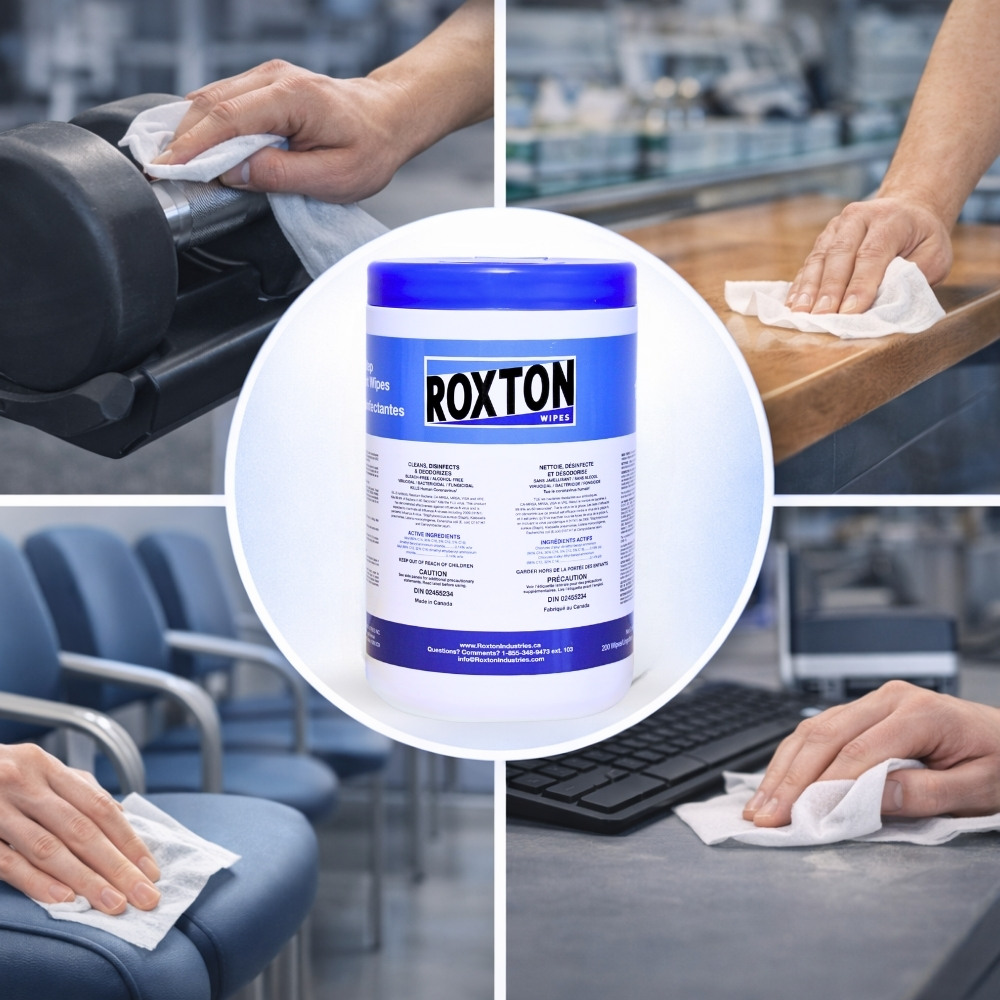
Roxton Wipes are registered with Health Canada under DIN 02455234, which means the disinfecting claim on the label is backed by the same efficacy data Health Canada requires of every registered disinfectant, not a marketing decision. They’re validated against MRSA, VRE, E. coli O157:H7, Salmonella, Influenza A (including H1N1), Herpes Simplex 1 and 2, Staph, and HIV-1, and formulated alcohol-free, bleach-free, and non-scented so they’re safe to use in sensitive environments like schools, daycares, and healthcare facilities.
If your current routine has a step for “clean” but not one for “disinfect with something that’s actually registered to disinfect,” that’s the gap Roxton is built to close.
See the full product spec and order Roxton Wipes.
Frequently Asked Questions
What’s the difference between cleaning, sanitizing, and disinfecting?
Cleaning removes dirt and some germs but doesn’t kill pathogens. Sanitizing reduces germ counts to a level public health standards consider safe, but doesn’t kill all bacteria or viruses. Disinfecting kills a broad spectrum of bacteria, viruses, and fungi outright. Sanitizing cannot substitute for disinfecting on surfaces that require it.
Do I need to clean a surface before disinfecting it?
Yes. Cleaning removes the dirt and debris that can shield germs from a disinfectant, so surfaces that are cleaned first respond better to disinfection than surfaces that are only wiped once.
What does “DIN-registered” mean?
A DIN, or Drug Identification Number, is issued by Health Canada to products that have submitted efficacy data proving they disinfect as claimed. Only DIN-registered products are legally allowed to claim they disinfect in Canada.
Why does contact time matter?
A disinfectant only kills the organisms on its label if the surface stays visibly wet for the full contact time specified. Wiping and moving on too quickly means the surface was cleaned, not disinfected, even if a disinfectant product was used.
About Roxton Managment

Leave a Reply Cancel reply
Latest Posts

Comments (2)
[…] on the product’s own label, and in Canada it’s tied directly to the product’s Drug Identification Number (DIN). A registered disinfectant’s label will list a contact time for each organism it’s […]
[…] or “sanitizing” and still not be legally authorized to disinfect anything. In Canada, that authorization comes from a Health Canada Drug Identification Number (DIN), and it applies to the specific formulation, not the size of the box it ships […]